


ORAL SURGERY
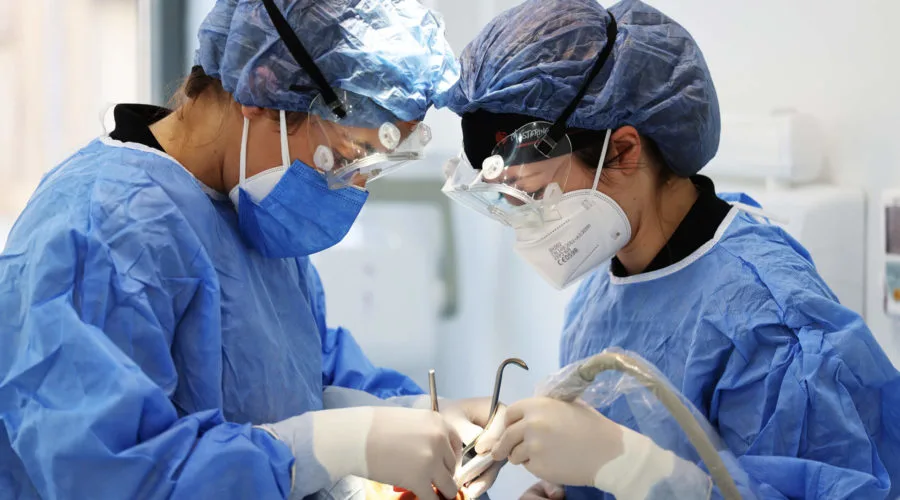
ORAL SURGERY
It covers all surgical procedures related to the extraction of teeth that can no longer be preserved in the oral cavity, such as teeth with extensive and non-restorable decay, teeth without bone support, impacted teeth, wisdom tooth extractions, among others.
CLOSER TO YOU
Extraction of single teeth
Tooth extraction may be necessary for a number of reasons, such as: extensive caries and the impossibility of restoration; severe bone loss or the need to make space in the dental arch. This oral surgery is usually carried out under local anaesthesia, depending on its degree of complexity.
Complex tooth extraction
Teeth can become impacted because of a lack of space in the arch, because they have an anomalous anatomy or because they are incorrectly positioned in the bone. If they are not removed, the constant pressure caused by the attempt to erupt them can cause various problems, such as resorption or cavities in neighbouring teeth, inflammation, pain and crowding (poor positioning of the teeth). Because of this problem, wisdom teeth, the last teeth to erupt, are often extracted.
Removal of cysts and tumours
Cysts and tumours in the facial region can be related to infected or impacted teeth, but they can also be unrelated to or originate from any tooth. These lesions are usually painless and are ‘discovered’ on X-rays or at check-ups. When they do appear, they should be removed and sent to be analysed for identification. Removing cysts or tumours requires oral surgery.
Bone grafts
Complex clinical situations resulting from infections or accidents with significant loss of bone structure may require oral bone graft surgery. These procedures are carried out in conjunction with other dental specialities, such as maxillofacial or general surgery, in order to harvest bone for grafting. Large bone defects or jaw fracture accidents are examples of clinical situations in which these procedures can be used.
More than 25 years at the service of excellence.
